

Key Takeaways
Six psychological shortcuts hijack your decisions before you think
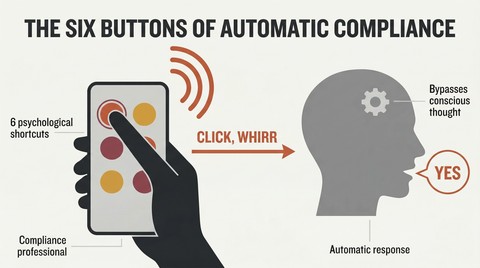
Cialdini spent three years undercover posing as a sales trainee, fund-raiser, and advertiser to study compliance from the inside. He discovered that virtually all persuasion tactics exploit six fundamental psychological shortcuts — what he calls "click, whirr" responses, after the mechanical way a tape plays when triggered by a single cue.
The foundational metaphor is the mother turkey. She nurtures anything making her chicks' "cheep-cheep" sound — even a stuffed polecat, her natural enemy. Humans are similarly wired. We use heuristics like "expensive = good" or "expert = trustworthy" to navigate a world too complex for careful analysis of every decision. These shortcuts usually serve us well. But compliance professionals know exactly which buttons to push to trigger our automatic "yes."
An unrequested favor creates obligation that overpowers even disliking
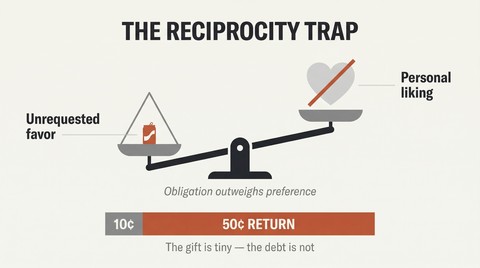
Reciprocity is the most potent principle. In a Cornell experiment, a researcher named "Joe" bought subjects an unsolicited ten-cent Coke. Later, Joe asked them to buy twenty-five-cent raffle tickets. Those who received the Coke bought twice as many — regardless of whether they liked Joe. The reciprocity rule completely overwhelmed personal preference.
The Hare Krishnas exploited this by pressing flowers on airport travelers who didn't want them — the unwanted gift still triggered obligation. Even Ethiopia, gripped by famine in 1985, sent $5,000 in disaster relief to Mexico, repaying aid Mexico had provided fifty years earlier. The Disabled American Veterans found that including unsolicited address labels with donation requests nearly doubled their response rate, from 18% to 35%.
Start with an absurd ask so your real request feels like a concession
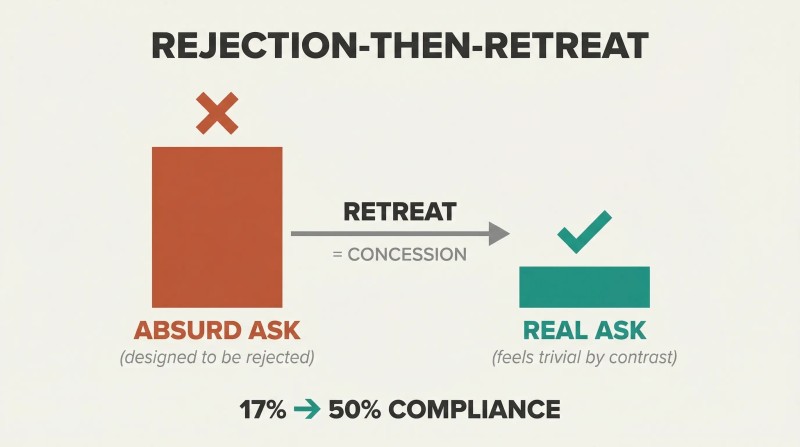
A Boy Scout asked Cialdini to buy five-dollar circus tickets. When he declined, the boy retreated: "How about some chocolate bars for a dollar?" Cialdini bought two — despite disliking chocolate. The retreat felt like a concession demanding a matching concession in return.
This rejection-then-retreat technique combines reciprocity with the contrast principle: after the large request, the smaller one looks trivially easy. In Cialdini's zoo-trip experiment, the approach tripled compliance — from 17% to 50%. The Watergate break-in may be history's most consequential example: G. Gordon Liddy first proposed a $1 million scheme including kidnapping squads and call girls, then retreated to the $250,000 burglary plan that ultimately destroyed Nixon's presidency.
Small commitments warp your self-image and open the door to big ones
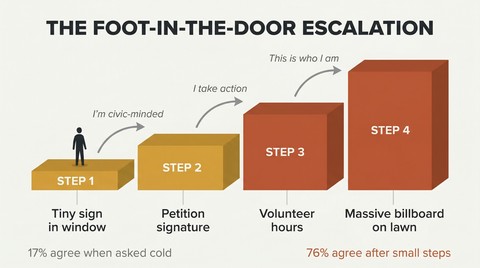
This is the foot-in-the-door technique. California homeowners who agreed to display a tiny "Be a Safe Driver" sign were later six times more likely to allow a massive, ugly billboard on their lawn — 76% agreed versus 17% asked cold. The small act had shifted how they saw themselves: as civic-minded people who take action.
Chinese POW camps applied this systematically. Captors began with trivial concessions — "The United States is not perfect" — then escalated to written essays, signed lists, and radio broadcasts. Each step seemed harmless, but the cumulative effect reshaped prisoners' self-images from loyal soldiers to collaborators. Written commitments proved especially powerful because they created undeniable physical evidence that drove self-image into alignment with action.
Commitments grow their own legs — remove the reason, the decision stands
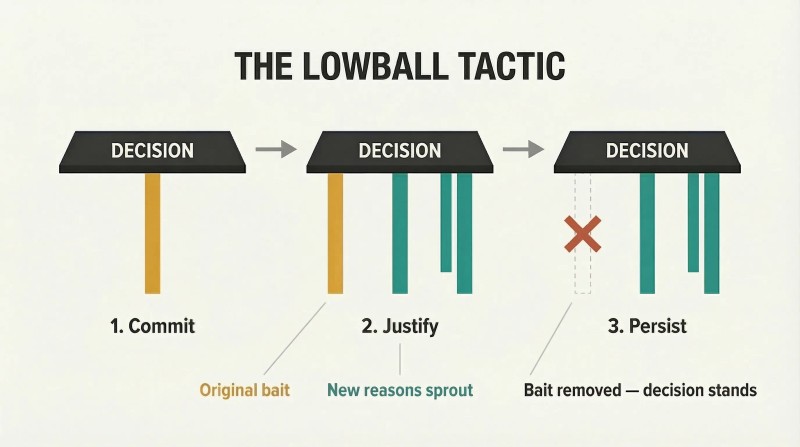
This is the lowball tactic. Car dealers offer an irresistible price to secure a buyer's commitment. During paperwork, the customer develops fresh justifications — the color, the handling, imagining neighbors' reactions. Then the dealer "discovers" an error raising the price by $400. Most buyers stay, propped up by reasons that sprouted only after the decision was made.
Iowa researchers demonstrated this beautifully with energy conservation. Homeowners promised newspaper publicity for conservation saved 12.2% on natural gas. When the publicity was canceled, they didn't revert — they saved even more, 15.5%, because they'd internalized new reasons: environmental responsibility, lower bills, pride in self-discipline. The original inducement had become the least important leg holding up the decision.
In an emergency, point at one person and assign a specific task
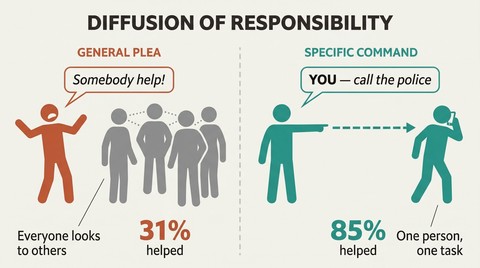
The Kitty Genovese murder defined an era. Thirty-eight neighbors watched her attacked over 35 minutes in 1964 Queens without calling police. The explanation wasn't apathy — it was pluralistic ignorance, where each person looks to others for cues, sees only calm faces, and concludes nothing is wrong. Meanwhile, everyone else is doing the same.
Research confirmed the pattern: a seizure victim received help 85% of the time from a lone bystander, but only 31% with five present. Cialdini applied this after his own car accident: bleeding and dazed, he pointed at individual drivers and commanded, "You, call the police." "You, pull over — we need help." Response was instantaneous. Specificity — who, what, now — breaks through the diffusion of responsibility.
We unconsciously copy people similar to us — even into fatal decisions
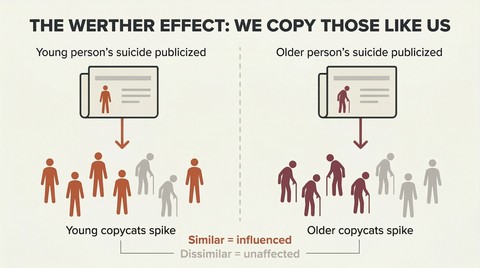
Sociologist David Phillips documented the Werther effect — named after Goethe's 1774 novel whose protagonist's suicide triggered real copycat deaths across Europe. Phillips found that within two months of every front-page suicide story, an average of 58 additional Americans kill themselves, concentrated in regions where the story received heaviest coverage.
The similarity matching is chilling. When a young person's suicide makes headlines, it's young drivers who die in subsequent single-car crashes; when an older person's suicide is publicized, older drivers perish. Phillips argues many post-publicity "accidental" fatalities are disguised copycat suicides. The principle of social proof operates most powerfully when we observe people who resemble us — a finding that extends from wallet-return experiments to the Jonestown mass suicide.
Separate how much you like the seller from the merits of the deal
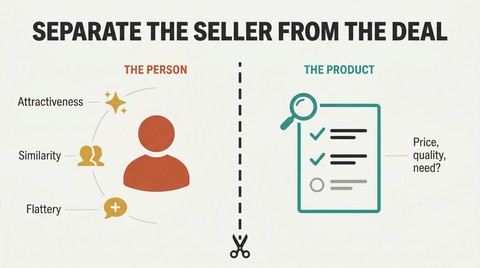
Liking operates through invisible channels. Attractive Canadian political candidates received 2.5 times more votes, though 73% of voters denied appearance influenced them. Salespeople are trained to mirror customers' body language, mention shared backgrounds, and "discover" common hobbies in the trade-in's trunk. Even transparently manipulative flattery works — men who knew a flatterer wanted something from them still liked him best when he gave only praise.
The Tupperware party is the masterclass. The real persuader isn't the demonstrator — it's the friend who hosted the party. Research shows the social bond to the hostess is twice as likely to drive purchases as actual product preference. Cialdini's defense: don't try to prevent liking from forming. Instead, when you notice it happening suspiciously fast, mentally separate the person from the product.
A title or uniform triggers obedience — even without real expertise behind it
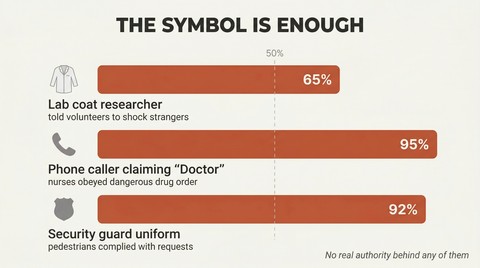
Milgram's experiment is psychology's most disturbing result. Ordinary volunteers administered what they believed were dangerous electric shocks to a screaming stranger simply because a lab-coated researcher directed them to continue. Two-thirds went to the maximum 450-volt level. Women obeyed at equal rates. Not one of forty subjects stopped before the victim demanded release at 300 volts.
The pattern extends beyond the lab. When a researcher phoned nurses posing as an unknown "doctor" and ordered double the maximum dosage of an unauthorized drug, 95% headed straight to the medicine cabinet. A security guard's uniform increased pedestrian compliance from 42% to 92%. Even actor Robert Young sold mountains of Sanka coffee using his fictional "Marcus Welby, M.D." authority. Defense: ask "Is this a genuine expert?" and "How truthful can they afford to be?"
Scarce things feel more desirable but don't perform any better
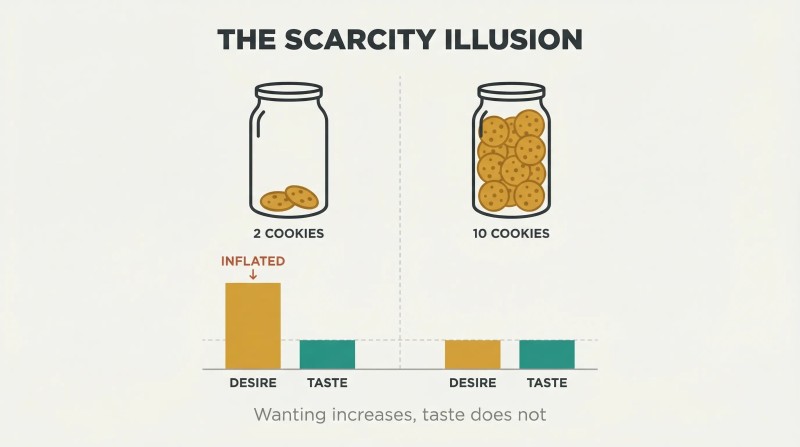
Worchel's cookie experiment proved the point. Participants who received a jar of two cookies instead of ten rated them as more desirable, more attractive, and more costly. But they didn't rate them as better-tasting. Scarcity inflated wanting without improving the actual experience.
Compliance professionals exploit this through limited-number tactics ("only five left") and deadline pressure ("offer expires tonight"). Cialdini's brother Richard sold used cars by scheduling multiple buyers at the same appointment time — creating visible rivalry over a contested resource. The first prospect, watching a competitor arrive, would panic and buy at full price. The defense is a two-step sequence: first, use the surge of competitive arousal as a warning signal to pause; then ask whether you want the item to use it or merely to own it.
Freedoms once granted then revoked spark fiercer defiance than constant deprivation
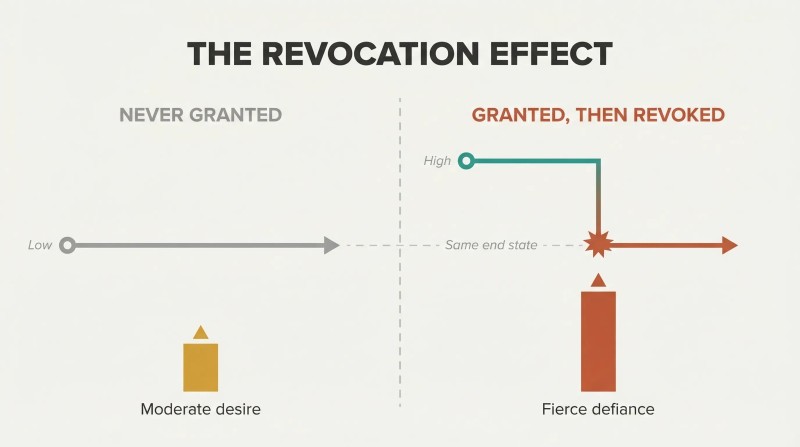
Newly scarce is explosively more motivating than always scarce. In Worchel's cookie study, participants who watched their supply drop from ten to two rated those cookies highest of all — higher than participants who had only two from the start. The transition from abundance to scarcity, not scarcity itself, triggered the strongest desire.
Historian James C. Davies showed that revolutions — French, Russian, American Civil War, 1960s urban riots — erupt after periods of rising prosperity are sharply reversed. The Soviet coup of 1991 collapsed in three days because citizens who'd tasted Gorbachev's glasnost refused to surrender it. The same psychological reactance — our drive to reclaim threatened freedoms — explains why inconsistent parenting produces more rebellion than consistent strictness, and why the "Romeo and Juliet effect" intensifies young love under parental opposition.
Analysis
Cialdini's Influence endures because it achieves what few psychology books manage: a unified theory of compliance that is simultaneously rigorous and immediately practical. Published in 1984, its six-principle framework has only grown more relevant as digital platforms have weaponized every mechanism it describes. Social proof now operates at the speed of trending hashtags; scarcity is manufactured by countdown timers; reciprocity fuels the freemium economy; authority is borrowed through verified badges and white-coat imagery.
The book's deepest contribution is not any individual principle but its meta-argument about cognitive efficiency. Cialdini recognizes that mental shortcuts are not character flaws — they are adaptations to overwhelming complexity. The mother turkey's cheep-cheep heuristic works correctly in virtually every natural circumstance. The danger arrives only when someone deliberately counterfeits the signal. This reframes the ethical question precisely: the enemy is not persuasion itself but the fabrication of legitimate decision cues.
What separates Cialdini from pop psychology is methodological range. He fuses controlled experiments — Milgram's obedience paradigm, Freedman and Fraser's foot-in-the-door, Worchel's cookie jar — with three years of participant observation inside sales floors, fund-raising operations, and cult recruitment. This dual lens gives the work a credibility that armchair theorizing cannot match and that subsequent behavioral-economics bestsellers have largely replicated in spirit.
A sophisticated critique might note that the six principles are not fully independent. Rejection-then-retreat simultaneously engages reciprocity, contrast, and commitment. The Tupperware party deploys all six in a single living room. Cialdini acknowledges these overlaps but does not formally model interactions between principles — a limitation later research has begun to address.
Perhaps the book's most subversive contribution is its defense playbook. By teaching readers to recognize internal signals of manipulation — the tightening stomach, the inexplicable rapport with a stranger, the competitive arousal over a scarce item — Cialdini transforms passive targets into informed agents. The knowledge is dual-use, but the asymmetry favors awareness: recognizing the game changes the odds permanently.
Review Summary
Influence receives mostly positive reviews for its insights into persuasion psychology. Readers appreciate the well-researched examples and practical applications. Many find it eye-opening and valuable for understanding marketing tactics and human behavior. Some criticize the repetitive writing style and outdated references. The book outlines six key principles of influence: reciprocation, commitment, social proof, liking, authority, and scarcity. While some content may seem obvious, many readers find it a useful guide for both recognizing and defending against manipulation techniques in various aspects of life.
People Also Read








Glossary
Weapons of influence
Six core compliance principlesCialdini's term for the six fundamental psychological principles—reciprocation, commitment/consistency, social proof, liking, authority, and scarcity—that compliance professionals exploit to get people to say yes. Each operates as a shortcut that normally guides good decisions but can be triggered inappropriately by those who understand the mechanism.
Click, whirr
Automatic triggered behavioral responseCialdini's metaphor for the mechanical, unthinking way humans respond to trigger features—like a tape being activated. 'Click' is the trigger (a title, a gift, a crowd's behavior); 'whirr' is the automatic compliance response that follows. Borrowed from ethology's concept of fixed-action patterns in animals, where a single stimulus cue launches an entire behavioral sequence.
Rejection-then-retreat technique
Large-then-small request strategyA compliance tactic where the requester first makes an extreme request expected to be refused, then retreats to a smaller request—the one actually desired. The retreat is perceived as a concession, triggering reciprocal concession from the target. Also engages the contrast principle, making the second request seem smaller by comparison. Cialdini also calls it the 'door-in-the-face' approach.
Foot-in-the-door technique
Small commitment escalating to largeA compliance strategy in which a small, easy-to-grant initial request is used to increase the likelihood of compliance with a larger, related request later. The mechanism works through self-image change: agreeing to the small request alters how people see themselves, making them more likely to act consistently with that new self-concept when the bigger ask comes.
Lowball tactic
Removing incentive after commitmentA compliance technique where an attractive offer secures a person's decision, and then the original incentive is removed or modified after commitment is made. The decision typically stands because the person has generated new supporting reasons during the commitment period. Common in car sales, where a great price is offered, then an 'error' raises it after the buyer has emotionally committed.
Pluralistic ignorance
Group misreading calm as safetyA phenomenon where each individual in a group looks to others for cues about whether a situation is an emergency, sees everyone else appearing calm (because they are also looking around rather than reacting), and concludes nothing is wrong. This collective misinterpretation of inaction as informed calm helps explain bystander inaction during emergencies.
Werther effect
Copycat suicides after publicityNamed after Goethe's novel whose hero's suicide triggered real imitative deaths across Europe, the Werther effect describes the documented increase in suicides following highly publicized suicide stories. Sociologist David Phillips showed the effect is concentrated in regions where the story received the most coverage, and that the demographic profile of the publicized victim predicts which demographic groups show increased fatalities afterward.
Psychological reactance
Desire for restricted freedoms increasesA theory developed by psychologist Jack Brehm proposing that whenever free choice is limited or threatened, the need to retain those freedoms makes people desire them—and the goods or services associated with them—significantly more than before. Explains phenomena from the 'terrible twos' and teenage rebellion to consumer hoarding of banned products and increased support for censored political speech.
Contrast principle
Relative perception shifts after comparisonA principle of human perception where the difference between two things presented sequentially is exaggerated. If you lift a light object then a heavy one, the heavy one feels heavier than it would alone. Compliance professionals use this by presenting expensive items first (making accessories seem cheap) or extreme requests first (making the real request seem modest).
Luncheon technique
Pairing food with persuasion targetsPsychologist Gregory Razran's method of presenting persuasive messages while subjects eat, exploiting Pavlovian association to transfer the positive feelings generated by food to whatever information accompanies it. Razran found that political statements gained approval when presented during meals. The technique underlies the political tradition of lobbying legislators over dinner and holding fund-raising events around food.
Halo effect
One trait dominates overall perceptionA cognitive bias where one positive characteristic of a person—most commonly physical attractiveness—dominates how that person is perceived across unrelated dimensions. Research shows we automatically assign attractive people favorable traits like talent, kindness, and intelligence without awareness that appearance is influencing the judgment. Affects hiring decisions, criminal sentencing, and election outcomes.
FAQ
What's Influence: The Psychology of Persuasion about?
- Understanding persuasion techniques: The book delves into the psychological principles that explain why people comply with requests and how these can be used to influence behavior.
- Six key principles: Cialdini identifies six "weapons of influence"—reciprocation, commitment and consistency, social proof, authority, liking, and scarcity—that are central to human behavior.
- Real-world applications: The author combines experimental research with real-life observations, offering insights into how these principles are applied in fields like sales and marketing.
Why should I read Influence: The Psychology of Persuasion?
- Enhance decision-making skills: Understanding these principles can help you make more informed decisions and recognize manipulation.
- Practical examples: Cialdini uses engaging anecdotes and experiments to illustrate how these principles work in everyday situations.
- Personal empowerment: Learning these techniques can help you navigate social interactions and protect yourself from unwanted persuasion.
What are the key takeaways of Influence: The Psychology of Persuasion?
- Weapons of influence: The book outlines six fundamental principles that can be used to persuade others or defend against manipulation.
- Automatic compliance: Many decisions are made mindlessly, highlighting the importance of being aware of these automatic responses.
- Social proof and uncertainty: People often look to others for guidance in uncertain situations, which can lead to collective inaction or action.
What are the best quotes from Influence: The Psychology of Persuasion and what do they mean?
- “Everything should be made as simple as possible, but not simpler.”: Emphasizes clarity in communication and warns against oversimplification.
- “It is easier to resist at the beginning than at the end.”: Highlights the importance of early decision-making to avoid unwanted commitments.
- “Where all think alike, no one thinks very much.”: Warns against conformity and the lack of critical thinking when following the crowd.
What are the six principles of influence discussed in Influence: The Psychology of Persuasion?
- Reciprocation: People feel obligated to return favors, which can be exploited in social situations.
- Commitment and Consistency: Once committed, individuals tend to act consistently with that commitment.
- Social Proof: People look to others' behavior to determine what is correct, especially in uncertain situations.
How does the principle of reciprocation work in Influence: The Psychology of Persuasion?
- Obligation to repay: When someone does a favor, we feel a strong social obligation to return it.
- Uninvited favors: Even unsolicited favors can create a sense of indebtedness.
- Real-world examples: Charity organizations use unsolicited gifts to increase donation rates, demonstrating this principle's effectiveness.
What is the foot-in-the-door technique mentioned in Influence: The Psychology of Persuasion?
- Small request leading to larger: Involves getting someone to agree to a small request, increasing the likelihood of compliance with a larger one.
- Self-perception theory: Agreeing to a small request can change a person's self-image, making them more likely to comply with subsequent requests.
- Research support: Studies show that individuals who commit to small actions are more likely to engage in larger actions consistent with their new self-image.
How does social proof influence behavior according to Influence: The Psychology of Persuasion?
- Behavior of others as guidance: In uncertain situations, people look to others' actions to determine appropriate behavior.
- Pluralistic ignorance: Occurs when individuals in a group fail to act because they assume others are not concerned.
- Real-life implications: Social proof can lead to bystander apathy in emergencies, emphasizing the need for individual initiative.
How does liking influence compliance in Influence: The Psychology of Persuasion?
- Favorable responses: People are more likely to comply with requests from individuals they like or find attractive.
- Factors that enhance liking: Physical attractiveness, similarity, and compliments can increase liking.
- Tupperware parties example: Demonstrates how social dynamics of friendship and liking drive sales.
What is the significance of authority in Cialdini's work?
- Trust in expertise: People are more likely to comply with requests from perceived experts or authority figures.
- Milgram's experiments: Demonstrates how ordinary people can inflict harm under the direction of an authority figure.
- Symbols of authority: Titles, clothing, and other symbols can create an illusion of authority, leading to compliance.
How does scarcity affect our decision-making according to Influence: The Psychology of Persuasion?
- Increased value: Items become more desirable when perceived as limited in availability, prompting urgency.
- Psychological reactance: When freedoms are restricted, people often desire the restricted items more.
- Marketing strategies: Businesses use scarcity tactics, like limited-time offers, to drive sales and create competition.
How can I protect myself from being influenced according to Influence: The Psychology of Persuasion?
- Awareness of techniques: Recognize when someone is trying to manipulate you and take steps to resist.
- Evaluate commitments: Ensure commitments align with your true beliefs and values to avoid consistency pressures.
- Question social proof: Assess situations independently rather than relying solely on others' behavior.
About the Author
Other books by Robert B. Cialdini


Download PDF
Download EPUB
.epub digital book format is ideal for reading ebooks on phones, tablets, and e-readers.








































